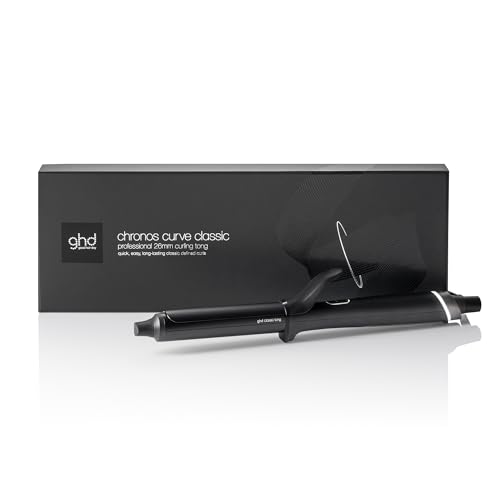
A curling iron works the same way a straightener does — heat reshapes the hair's internal bonds — but the barrel, not the plate, is what determines the result. Barrel diameter is the single biggest decision: a narrow barrel under 19mm produces tight, defined curls that drop into looser waves over a few hours, while a barrel over 32mm produces a soft, loose wave that can look almost undone. Clamp versus clipless is the second decision, and it is really a trade-off between ease and a visible crease — a clamp holds hair in place for a more even curl but can leave a faint line where it grips. The picks below are curling irons available on Amazon UK, ranked on customer rating weighted by review volume.
We compare every product in this category on customer rating, review volume, price and listed ingredients. We do not accept payment for placement, and we do not test products ourselves — the ranking reflects what Amazon UK shoppers actually rated.
Prices and availability are accurate as of the date shown and are subject to change on Amazon.
What to look for
Barrel size decides the curl, not the brand
Under 19mm gives tight ringlets, 19-25mm gives classic curls, 25-32mm gives loose curls, and over 32mm gives a beach-wave finish. Choosing by the result you want in a mirror is more reliable than choosing by price.
Clipless irons avoid the crease but need more skill
Without a clamp holding the section, there is nothing to leave a line, but you have to hold the hair against the barrel yourself, which takes practice and is slower at first. Clamp irons are more forgiving for a beginner.
Conical barrels create a more natural taper
A barrel that narrows towards the tip produces a curl that is tighter at the ends and looser at the root, which tends to look more like an undone wave than a uniform curl from a straight barrel.
Material affects glide as much as heat
Ceramic and tourmaline-coated barrels reduce friction and snagging as hair moves over them. A bare metal barrel on fine or damaged hair is more likely to catch and stress the strand during the curl.
Curl direction and technique change the result more than the tool
Curling every section in the same direction gives a uniform, slightly obvious pattern; alternating direction away from the face gives a softer, more natural look. This is technique, and no iron does it automatically.
Heat-resistant gloves are not optional for clipless irons
Holding hair against an exposed barrel without one is a genuine burn risk, particularly for anyone new to the tool. A glove that comes with the iron is worth using every time, not just while learning.
Frequently asked questions
What size curling iron should I buy?
For tight curls choose under 19mm, for classic curls 19-25mm, and for loose waves 25mm or above. Shorter hair generally suits a smaller barrel simply because there is less length for a large barrel to work with.
How long do curls from a curling iron last?
A few hours to a full day, depending on hair type and whether the curl is set with a cool-shot or spray before it drops. Fine, freshly washed hair holds a curl less well than hair with some texture or product already in it.
Is a clipless curling wand better than a clamp iron?
Neither is strictly better — a wand avoids a crease line but takes more practice, while a clamp iron is faster to learn and more consistent for a beginner. Many people who curl often eventually prefer a wand once the technique is familiar.
How do I stop curls dropping straight out?
Curl small sections rather than large ones, hold each curl briefly against the head to cool in its shape before releasing, and avoid brushing curls out immediately — running fingers through gently keeps more definition than a brush.
Can I use a curling iron on short hair?
Yes, with a smaller barrel. Very short hair struggles to wrap around a large barrel with enough length left to form a visible curl, so a narrower barrel is the more workable choice.