
Why creasing happens in the first place
Concealer sits as a distinct layer on top of skin rather than blending into it chemically, and that layer separates over the course of a day as skin moves, produces natural oil, and loses a little moisture. Where that separation happens to fall along a fine line — most often under the eyes, where skin is thinnest and most mobile — the product collects into a visible crease rather than staying flat. Heavier layers of product have more to separate and more distance to travel into a line, which is why creasing shows up disproportionately under the eyes rather than elsewhere on the face.
Coverage level is a trade-off, not just a preference
A heavier-coverage concealer generally means more pigment and more product sitting on the surface, which conceals more but also gives creasing more to work with if it isn't set properly. A lighter-coverage concealer sits thinner and creases less readily, at the cost of covering less in one layer. In this dataset, concealers span £5.49 to £52.35, and price does not reliably predict which end of that coverage trade-off a given product sits at — checking the coverage level stated on the listing matters more than the price alone.
Shade name is a genuine clue, not just marketing
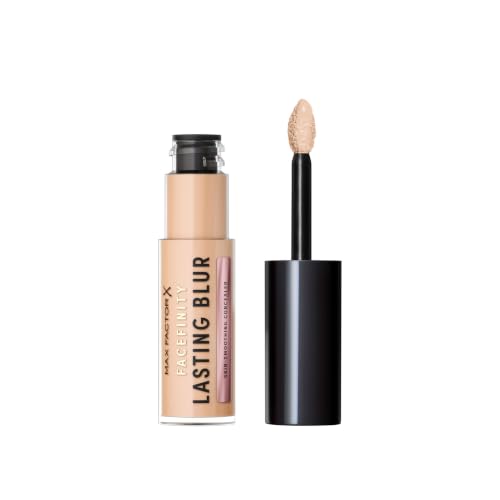
Shade names in this category are not random — Revlon's Warm Sand and the 'Deep' shades from Max Factor and Maybelline signal a warmer or deeper base than Rimmel's and Revlon's 'Ivory' options, which sit at the lighter end. Reading the shade name alongside a swatch, rather than guessing from the product photo alone, narrows the list faster than trial and error. A mismatched undertone — too pink, too orange, too light or too dark against your actual skin — creates visible contrast at the edges of the concealed area, which reads as a line even before any genuine texture-based creasing sets in.
Setting technique matters as much as the product
A light dusting of loose powder, applied with a soft brush over the concealed area once it's blended, creates a barrier that limits how much the product can shift during the day. Too much powder is its own problem — it can sit on top of the concealer and settle into the same lines it was meant to prevent, giving a cakey rather than a smooth finish. A light, targeted application under the eyes specifically, rather than a heavy dusting across the whole face, is generally the more effective approach for this particular problem.
The tool changes the result
A damp sponge presses concealer into skin and blends the edges softly, generally giving the most seamless, least detectable finish for everyday coverage. A brush gives more precise placement and can build coverage in a smaller, more targeted area, which suits spot-concealing over a blemish better than blending a wider area like the under-eye. Fingertips work but warm the product as they blend, which can make it easier to move around but slightly harder to control precisely — worth testing against a sponge or brush if creasing keeps recurring with the same product.
The common mistake: applying concealer straight from the tube
Applying concealer directly from the tube onto skin, then blending in place, tends to deposit more product than intended and doesn't allow for controlling the amount before it goes on. Dispensing a small amount onto the back of your hand first, then picking up only what's needed with a sponge or brush, gives far more control over how much ends up on the skin — and a thinner, more deliberate layer is one of the simplest ways to reduce creasing regardless of which specific product is being used.
Concealers to consider
Real concealer listings on Amazon UK. See the full concealer page for the complete, sortable list.
4 products


Related products
More real listings on Amazon UK related to this article. See the full concealer page for the complete, sortable list.
4 products



Frequently asked questions
- What type of concealer creases the least?
- A lighter-coverage formula, applied thinly with a damp sponge and set with a light dusting of loose powder only where needed, tends to crease the least. Heavy layers of high-coverage product are more prone to settling into fine lines over the course of a day.
- How do I find the right shade of concealer?
- Swatch it along your jawline or the back of your hand in natural daylight rather than indoor lighting, and pay attention to the shade name — 'warm', 'deep' or 'ivory' style names are a genuine clue to undertone and depth, not just marketing language.
- Should I set concealer with powder or moisturiser?
- Powder is more effective specifically at preventing creasing, particularly for oilier skin. A light layer of moisturiser or primer underneath the concealer can help it sit more smoothly in the first place, but powder afterwards is what actually locks it in place through the day.
- Can I apply concealer straight from the tube?
- It's better not to. Dispensing a small amount onto the back of your hand first and picking up only what you need with a sponge or brush gives more control over the amount applied — a thinner layer is one of the simplest ways to reduce creasing.
Related guides
Petal & Proof Editorial Team
We do not test products hands-on — see our editorial policy for how listings are sourced and ranked.
Last updated 9 August 2026 · 767 words